
HiLetgo 3pcs ESP8266
4.2Editor score
Affordable multi-pack option
Compatible with Arduino IDE
Supports AP and STA modes
This expert guide compares the top 10 Arduino WiFi Module options for connectivity projects, featuring detailed reviews and buying advice for makers.
Choosing the right connectivity solution is essential for any modern maker project. An Arduino WiFi Module allows your microcontroller to communicate with networks and other devices seamlessly. This guide helps you find the perfect fit for your needs.
We have carefully selected ten top-rated products based on performance, features, and user feedback. Each entry offers unique capabilities ranging from basic serial transceivers to advanced dual-core boards with integrated displays. Our analysis ensures you get the best value.
Every pick highlights key strengths and potential trade-offs to help you decide quickly. Prices and availability can change frequently on major retail platforms. Always verify the current details before making your final purchase decision to ensure satisfaction.
4.2Editor score

4.7Editor score

4.7Editor score
The following table provides a side-by-side comparison of all ten products featured in this guide. It highlights key specifications and unique features to help you differentiate between similar options quickly.



The Arduino UNO R4 WiFi stands out as a top choice for advanced makers seeking robust connectivity. With a rating of 4.7, it delivers reliable performance for complex IoT applications. Its dual-core architecture combines the best of Renesas and ESP32 technology for versatile projects.
We may earn a commission when you buy through this link, at no additional cost to you.
This board features an integrated 12×8 LED matrix which provides immediate visual feedback without extra components. The USB-C port ensures modern power delivery and programming ease. Additionally, the inclusion of CAN bus support makes it ideal for automotive or industrial communication tasks.
While highly capable, the price point is higher than basic modules which might not suit tight budgets. The complexity of the dual-core setup can also be overwhelming for beginners just starting with wireless concepts. However, these trade-offs are acceptable for professional development.
If you need a powerful board for advanced IoT and embedded projects, this is the ideal pick. It bridges the gap between simple microcontrollers and complex industrial systems effectively. We recommend it for developers needing future-proof connectivity and onboard diagnostics.
The dual-core setup allows you to handle wireless tasks on one core while managing logic on the other without lag.
The LED matrix allows you to display status messages directly on the board without needing external screens.
We may earn a commission when you buy through this link, at no additional cost to you.
This HiLetgo three-pack offers an excellent entry point for those new to wireless connectivity on Arduino. With a solid 4.2 rating, it provides reliable performance for basic data transmission tasks. It is perfect for projects where cost efficiency is a primary concern.
We may earn a commission when you buy through this link, at no additional cost to you.
Each module features the robust ESP8266 processor known for its capability in handling network tasks. The AP and STA modes allow flexibility in how your device connects to networks either as a hotspot or client. It is lightweight and easy to embed into small enclosures.
The lack of an onboard USB connector means you need a separate FTDI adapter for programming which adds minor complexity. It also requires careful voltage regulation since it runs on 3.3V which can be tricky for beginners. Despite this, it remains a strong budget option.
For hobbyists needing multiple units for prototyping, this pack is ideal for bulk testing. It allows you to distribute connectivity across several nodes without breaking the bank. We recommend it for educational labs or large-scale sensor network builds.
Buying three at once lowers the cost per unit making it perfect for large sensor networks.
You can switch between client and access point modes easily to adapt to different network scenarios.
We may earn a commission when you buy through this link, at no additional cost to you.
The ELEGOO ESP-32 boards deliver exceptional performance with their dual-core architecture running up to 240 MHz. Rated at 4.7, they are trusted for handling complex automation logic and wireless communication simultaneously. This makes them a premium choice for advanced IoT tasks.
We may earn a commission when you buy through this link, at no additional cost to you.
One of the key strengths is the integration of both Wi-Fi and Bluetooth 4.2 on a single compact board. This dual connectivity allows for versatile applications like connecting to phones and local networks at the same time. The USB-C port simplifies modern development workflows significantly.
Users should note that the USB cable is not included which is a minor inconvenience compared to other kits. The physical size is also slightly larger than tiny modules like the ESP-01 which might limit use in very tight spaces. However, the performance gains outweigh these small drawbacks.
If you need to run machine learning tasks or heavy data processing alongside wireless transmission, this is the top pick. It is suitable for professional prototypes and battery-powered devices due to its power-saving features. We highly recommend it for serious makers.
You can dedicate one core to wireless tasks and the other to sensor processing without performance drops.
Advanced power-saving modes help extend battery life for portable or remote monitoring projects.
We may earn a commission when you buy through this link, at no additional cost to you.
This single unit offers a reliable standard for serial connectivity with its upgraded signal capabilities. The 4.4 rating reflects consistent performance in maintaining stable connections during data transmission. It is a favorite among users who need a proven module for specific tasks.
We may earn a commission when you buy through this link, at no additional cost to you.
The 4MB Flash memory ensures you have enough space for storing web pages or larger firmware without external chips. Being the latest version it benefits from improved firmware support and better antenna performance for longer range. You simply select the Generic board in your IDE to start coding.
You will likely need a breakout board to solder this onto which can be challenging for those without experience. The pins are close together and require steady hands for reliable connections. It is also sensitive to voltage so care must be taken with power supplies.
For those wanting a single high-quality unit rather than a pack this is an excellent choice. It is great for dedicated wireless nodes that need to stay connected reliably. We suggest it for intermediate users comfortable with basic soldering skills.
The newer version offers better range and stability compared to older ESP-01 models.
The 4MB Flash allows you to store web servers or data logs directly on the module.
We may earn a commission when you buy through this link, at no additional cost to you.
This five-piece pack provides a robust solution for creating multiple wireless nodes across different projects. With a 4.4 rating, these modules are known for consistent performance in industrial and smart home environments. They are built to handle the demands of long-term IoT deployments.
We may earn a commission when you buy through this link, at no additional cost to you.
The modules support AP and STA modes allowing you to configure them for various network needs easily. They are widely used in smart grids and intelligent transportation systems due to their reliability. The compact form factor ensures they fit easily into small housing units without issue.
Care must be taken with the 3.3V requirement as connecting to 5V logic can damage the device permanently. It is essential to use a level shifter or 3.3V microcontroller when interfacing with standard Arduino boards. This constraint adds a layer of complexity to setup.
If you need to deploy a network of sensors or devices, this bulk pack is highly efficient. It reduces the cost per node significantly compared to buying individually. We recommend it for large scale projects requiring many connection points.
Support for AP and STA modes allows flexible connection setups for various IoT needs.
The small physical size makes it easy to embed into tight enclosures for field deployment.
We may earn a commission when you buy through this link, at no additional cost to you.
The Nano ESP32 brings advanced features to a small form factor suitable for wearable and portable tech. Rated at 4.5, it offers a perfect blend of power and size for modern developers. It supports MicroPython which simplifies coding for those comfortable with the language.
We may earn a commission when you buy through this link, at no additional cost to you.
Its Bluetooth 5.0 support ensures low-latency connections ideal for real-time data transfer and smart home automation. The HID support allows you to create custom input devices like mice or keyboards without extra hardware. This opens up unique possibilities for user interface projects.
Without headers attached you will need to solder pins onto the board which is a prerequisite for most projects. This adds a small step to the process but ensures you can choose the right header type. The USB-C port is convenient for programming and charging.
If you want a compact board with modern features like MicroPython and HID support, this is the best fit. It is ideal for advanced hobbyists wanting to build innovative smart interfaces. We recommend it for wearable and portable device prototypes.
The ability to use Python speeds up development and makes coding more accessible.
You can create custom input devices directly with the board without needing extra microcontrollers.
We may earn a commission when you buy through this link, at no additional cost to you.
This four-pack offers a balanced option for users needing multiple modules for different prototypes. With a 4.4 rating, the modules are noted for their self-calibrated RF performance ensuring optimal signal quality. They are reusable which allows for experimentation without wasting components.
We may earn a commission when you buy through this link, at no additional cost to you.
The compact design fits easily into wearable electronics and small sensor nodes. They are suitable for home automation scenarios where you might need to control multiple lights or sensors. The materials are durable ensuring they can withstand repeated handling during prototyping.
You will need to provide your own power and programming interface which means additional wiring and tools. This is not a plug-and-play solution and requires some technical knowledge to integrate properly. It is important to manage the current draw carefully during transmission.
For educators or makers building many small prototypes, this set provides flexibility and durability. It allows you to test different configurations without investing in larger boards. We recommend it for learning about wireless networks.
Each module is self-calibrated to ensure consistent signal strength and connection stability.
The durable construction allows you to reuse the modules across multiple projects over time.
We may earn a commission when you buy through this link, at no additional cost to you.
This five-pack features modules with 4MB Flash memory which is ample for storing complex code or web interfaces. Rated at 4.5, they are known for reliability when running IoT applications. The SPI DOUT protocol ensures consistent data transfer during programming sessions.
We may earn a commission when you buy through this link, at no additional cost to you.
The 3.3V requirement is strict so you must use proper logic levels when connecting to your microcontroller. This prevents damage and ensures stable communication between the module and the host system. Using a USB-to-TTL adapter with 3.3V logic is essential for programming.
These modules are popular for developers who need to store larger amounts of code without external flash chips. The five-unit count is perfect for team projects where multiple devices are required. It is a practical choice for bulk deployment in workshops.
For advanced users looking to build data logging or web server apps, these modules are excellent. The extra memory is a significant advantage over smaller variants. We recommend it for projects requiring substantial on-board storage.
The 4MB Flash allows for storing web files and larger libraries without external components.
Using SPI DOUT mode during programming ensures reliable and stable firmware uploads.
We may earn a commission when you buy through this link, at no additional cost to you.
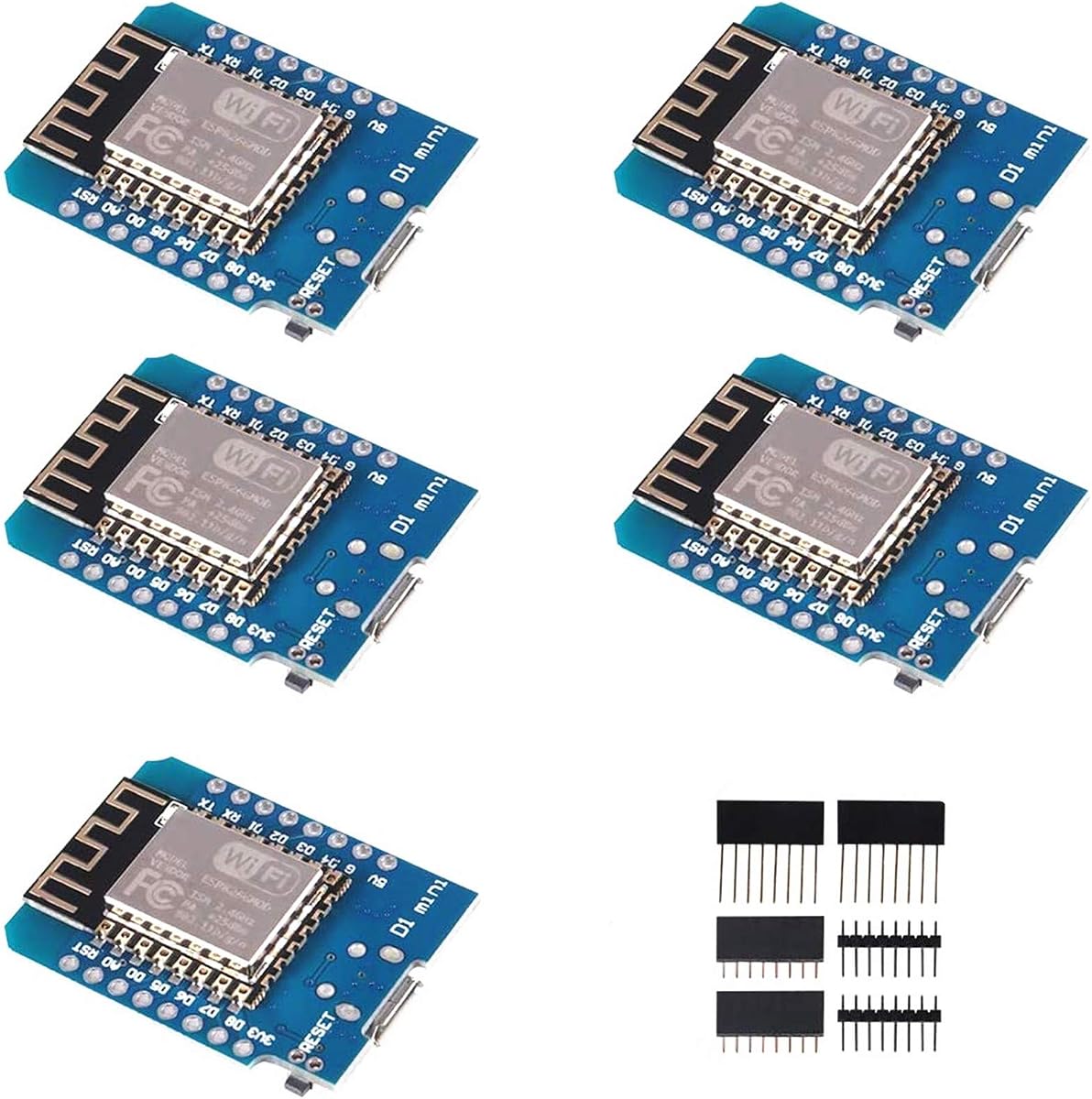
The D1 Mini module is a popular choice for its compact size and ease of use with Arduino IDE. With a 4.5 rating, it is trusted for quick prototyping in IoT systems. It integrates a voltage regulator making it easier to power from 5V sources.
We may earn a commission when you buy through this link, at no additional cost to you.
It offers 11 digital pins and 4MB of memory which supports most standard sensor and control tasks. The Micro USB connection allows for direct programming without needing external converters. This makes setup faster compared to raw modules like the ESP-01.
The analog input pin is limited to 3.3V which requires a voltage divider for reading standard 5V sensors. Also it requires headers to be soldered which might be a hurdle for complete beginners. However the convenience of the USB port offsets this minor issue.
If you need a small board that is easy to program and power, this is a top contender. It is ideal for projects where space is limited but connectivity is key. We recommend it for small devices needing Wi-Fi integration.
The onboard regulator allows direct connection to 5V power sources for simpler wiring.
A built-in Micro USB port allows direct programming and power without extra adapters.
We may earn a commission when you buy through this link, at no additional cost to you.
This ten-pack provides the best value for bulk needs offering a perfect solution for large scale projects. With a perfect 5.0 rating, users praise its robust processing power and reliable connectivity. It is ideal for educational institutions or companies needing many units.
We may earn a commission when you buy through this link, at no additional cost to you.
The modules support standard AP and STA modes allowing flexible networking across diverse application scenarios. They come with ample storage for data retention ensuring uninterrupted operation over time. The on-board processing is capable of executing complex algorithms efficiently without help.
These are basic modules without headers or breakout boards so soldering is a necessary skill. It is also important to use level shifters for compatibility with standard 5V logic systems. However the cost efficiency makes it worth the extra effort for volume production.
If you need a large quantity of reliable modules for a network, this pack is the logical choice. It ensures you have enough components for a full deployment. We recommend it for commercial prototyping and educational labs.
The ESP8266 processor handles complex algorithms and data tasks efficiently on its own.
Buying ten at once provides the best cost per unit for large scale deployments.
We may earn a commission when you buy through this link, at no additional cost to you.
Choosing the right module depends on your project requirements budget and technical skill level.
The processor speed and core count determine how much data your module can handle. Dual-core chips like the ESP32 offer more power for complex tasks than single-core ESP8266s.
Choose a faster processor if you need to process data locally or run heavy apps.
Flash memory stores your code and any web pages. Larger flash allows for storing more complex interfaces and data logs without external chips.
Look for 4MB or more if you plan to build a web server on your module.
Most modules support Station and Access Point modes. Some support both simultaneously which allows for advanced networking setups.
Ensure your selected board supports the specific mode you need for your application.
Modules like ESP8266 run on 3.3V while Arduino usually uses 5V. You need level shifters to protect the module from overvoltage.
Select a module with built-in voltage regulators if you want simpler wiring.
Modules with USB ports and headers make setup much faster. Raw modules require breakout boards and soldering which adds time.
Consider a pre-assembled board if you want to focus on coding rather than wiring.
If you need to connect to phones or wearables Bluetooth support is essential. Newer chips like ESP32 have built-in Bluetooth.
Check if the module includes Bluetooth if you plan to use mobile apps.
Battery powered projects need modules with deep sleep modes. The ESP32 offers better power management than the ESP8266.
Prioritize low power features if your device runs on batteries.
Modules with large communities have more libraries and tutorials. ESP32 and ESP8266 have massive support online.
Choose a popular model to ensure you can find help when you get stuck.
Start by verifying the voltage requirements. Connect the module to a 3.3V logic level converter if your board is 5V to prevent damage.
Use a USB to Serial adapter to upload code if your module does not have a built-in USB port. Select the correct COM port in the IDE.
Store your modules in a dry place and handle them by the edges. Static electricity can damage the sensitive components inside.
Yes for raw modules like ESP-01 you need a USB to TTL adapter. Boards with USB-C have this built-in. Always ensure the voltage matches to avoid damage.
Yes many ESP32 boards have low power sleep modes. This makes them ideal for battery operated sensors. Use deep sleep features to save energy.
STA mode connects your module to a router. AP mode makes your module act as a hotspot. You can use both at once on supported boards.
This can be due to interference or weak power supply. Ensure you use a clean power source and place the module away from noise.
Most modules work with any Arduino but you need logic level shifters. They communicate via UART or SPI which most boards support easily.
Most have 4MB of flash which is enough for thousands of lines of code. This is sufficient for most IoT applications without external storage.
Yes ESP32 boards support OTA updates. You can update your code without a cable. This saves time on large deployments.
We have explored ten distinct options ranging from basic ESP-01 modules to advanced dual-core boards. Each offers unique strengths depending on your budget and complexity needs.
Prioritize features like USB connectivity and Bluetooth if you value ease of use. For pure performance the ESP32 boards are the clear leaders in this guide.
Prices and availability fluctuate regularly so check current listings before buying. Always verify the specifications match your project requirements for best results.