
Sntieecr STEM Electric Circuit Motor Kit
4.2Editor score
Complete motor components
Affordable pricing
Easy assembly
Discover the best electricity learning kits for students and enthusiasts. We compare top kits for hands-on circuit building, magnetism experiments, and STEM
Electricity learning kits provide an engaging way to explore the fundamental principles of circuits and energy. These tools help students visualize abstract concepts through hands-on experimentation and interactive projects that build critical thinking skills.
We evaluated ten top-rated kits based on component quality, project variety, safety features, and educational value. Our selection includes options for different age groups and skill levels ranging from basic intro to advanced physics labs.
Each product review highlights key strengths, limitations, and ideal use cases for educators and parents. Prices may vary over time, so please check current listings before making your final purchase decision for your needs.
4.2Editor score

4.7Editor score

4.5Editor score
This side-by-side comparison highlights the core specifications and unique features of each selected kit to help you find the perfect match for your educational goals.



The EUDAX School Physics Labs kit ranks first for its focus on high school physics standards. With a 4.5 rating it delivers a robust set of tools for exploring electricity and magnetism together effectively.
We may earn a commission when you buy through this link, at no additional cost to you.
This set includes fifty six items for electricity and twenty one for magnetism allowing students to conduct Oersted experiments and measure unknown resistors. The manual guides learners through parallel circuits and hand crank generators with clear diagrams.
While batteries are not included, the storage bag keeps components organized. Students must handle tools carefully during assembly to avoid damaging fragile parts like the ammeter or resistors during repeated use.
Educators and parents seeking a serious STEM tool will appreciate its depth. It bridges textbook theory and lab practice making it ideal for grades nine to eleven students preparing for advanced science courses.
The kit uniquely balances electricity with magnetism experiments enabling deeper understanding of electromagnetic forces through hands-on builds.
Projects like Ohm's law resistor measurement align well with secondary education physics curricula for structured learning.
We may earn a commission when you buy through this link, at no additional cost to you.
This kit offers an accessible entry point for children aged eight to twelve. It holds a 4.5 rating and focuses on eight distinct circuit experiments designed to spark interest in electrical engineering basics.
We may earn a commission when you buy through this link, at no additional cost to you.
Projects include series and parallel circuits as well as saltwater power generation. The included circuit book provides easy-to-follow instructions making it ideal for home or classroom use without requiring expert supervision.
While it lacks complex tools, the simplicity encourages creativity. Users note that saltwater and fruit batteries can be messy so cleanup is required after each experiment to maintain component safety.
Families seeking affordable STEM education will find this a strong starting point. It teaches core concepts like conductivity without overwhelming young learners with too many variables or fragile parts.
The eight experiments balance simplicity with curiosity through fun options like fruit batteries that show real-world energy conversion.
Teachers can use this kit for science fairs or group activities because it allows parallel experimentation across multiple students.
We may earn a commission when you buy through this link, at no additional cost to you.
With a 4.7 rating this kit leads in project volume. It offers over one hundred twenty electrical activities ranging from light shows to amplified voice systems ensuring long-term engagement for curious kids.
We may earn a commission when you buy through this link, at no additional cost to you.
The snap-together design eliminates the need for tools while video instructions via QR code simplify setup. Components are designed for safety reducing risks for younger users exploring complex electrical pathways.
The main trade-off is price and component management. With so many parts, organization is critical to avoid losing pieces. Users recommend keeping the original box to maintain order during storage.
Families wanting maximum play value will enjoy this investment. It transforms learning into play through songs and copters making electricity accessible even to those who fear technical subjects.
Projects like keyboard mode and sound systems make abstract electrical concepts feel like entertainment rather than schoolwork.
Snap connectors ensure secure connections without loose wires reducing short circuit risks for independent learners.
We may earn a commission when you buy through this link, at no additional cost to you.
This kit stands out for its specialized physics modules like the Joule's first law experiment. It holds a 4.4 rating and includes fifty five items to teach both electricity and magnetism concepts clearly.
We may earn a commission when you buy through this link, at no additional cost to you.
The manual explains why experiments work not just how encouraging critical thinking. Every item has a fixed place in the storage case making it convenient to take outside or to class.
Though it may lack flashy components, its educational depth is strong. Students design custom experiments beyond the fifty in the manual fostering creativity and deeper understanding of circuit principles.
Parents wanting serious physics exposure without high costs should consider this. It balances educational rigour with accessibility for middle school learners ready to move beyond simple lights.
Clear illustrations and explanations turn passive assembly into active learning about scientific principles behind each build.
Specialized items like magnetic switches offer insights into real-world applications often missed in basic kits.
We may earn a commission when you buy through this link, at no additional cost to you.
Priced affordably this kit delivers core motor and circuit components. It holds a 4.2 rating and includes two motors plus propellers perfect for kids curious about how electricity creates motion.
We may earn a commission when you buy through this link, at no additional cost to you.
Users must control voltage carefully between 1.5V and 3V to avoid heat buildup. With proper supervision children can build simple circuits that drive fans and buzzers instantly.
The trade-off is limited complexity compared to premium sets. Yet it offers enough variety for multiple experiments without requiring expensive tools or parts to achieve meaningful learning outcomes.
For budget-conscious parents this is an ideal starting gift. It turns curiosity into invention with minimal cost making STEM accessible to families with limited resources.
Unlike kits with static lights this set emphasizes dynamic outputs like propellers showing energy conversion effectively.
The low price point reduces barriers to entry allowing more families to try hands-on electrical science.
We may earn a commission when you buy through this link, at no additional cost to you.
This set encourages family participation with its comprehensive components. It holds a 4.4 rating and offers eighteen experiments including electric bell and hand crank generators for interactive science sessions.
We may earn a commission when you buy through this link, at no additional cost to you.
The forty-page full-color manual supports parents in explaining concepts. Components like the voltmeter allow kids to measure real values adding a layer of scientific rigor to play.
While robust, users must manage small parts to avoid choking hazards. The durable design withstands frequent use making it suitable for repeated family discovery nights without wear.
Families wanting shared STEM time will value this kit. It builds critical thinking through guided experiments that both parents and children can enjoy together easily.
The manual and component mix fosters teamwork allowing adults to guide kids through complex builds safely.
Instruments like ammeters help kids learn precise electrical concepts rather than just binary on-off states.
We may earn a commission when you buy through this link, at no additional cost to you.
This kit mirrors the first product with a similar focus on high school curricula. It holds a 4.5 rating and provides specialized items like a sensitive ammeter to measure small currents accurately.
We may earn a commission when you buy through this link, at no additional cost to you.
The manual guides students through steps for each experiment including Ampere's force investigation. A double-layer storage box keeps components organized reducing time spent searching for parts.
Users should prepare three AA batteries in advance as they are not included. The complexity may overwhelm younger children but suits older learners ready for serious physics study.
Schools or parents seeking lab-quality tools will prefer this. It bridges classroom lessons and practical applications for students aiming for advanced science tracks.
The sensitive ammeter offers precision that basic kits lack enabling real measurement of current flow.
Double-layer storage ensures components remain secure during transport to school or study sessions.
We may earn a commission when you buy through this link, at no additional cost to you.
The most basic EUDAX kit focuses on series and parallel circuits. It holds a 4.6 rating and includes English instructions making it accessible for students seeking a clear introduction to electrical rules.
We may earn a commission when you buy through this link, at no additional cost to you.
This setup helps consolidate textbook knowledge through hands-on assembly. Components like LED and bulbs allow immediate visual feedback confirming theoretical understanding effectively.
It lacks magnetism items but remains safe and structured. Users note it is ideal for science clubs and summer camps where simplicity is valued over complexity.
Parents wanting a low-risk intro will find this ideal. It avoids overwhelming children while providing enough structure to build foundational skills.
English manuals and simple parts reduce frustration for those new to circuit assembly and theory.
Ideal for grades seven to nine science fairs requiring clear demonstration of basic electrical concepts.
We may earn a commission when you buy through this link, at no additional cost to you.
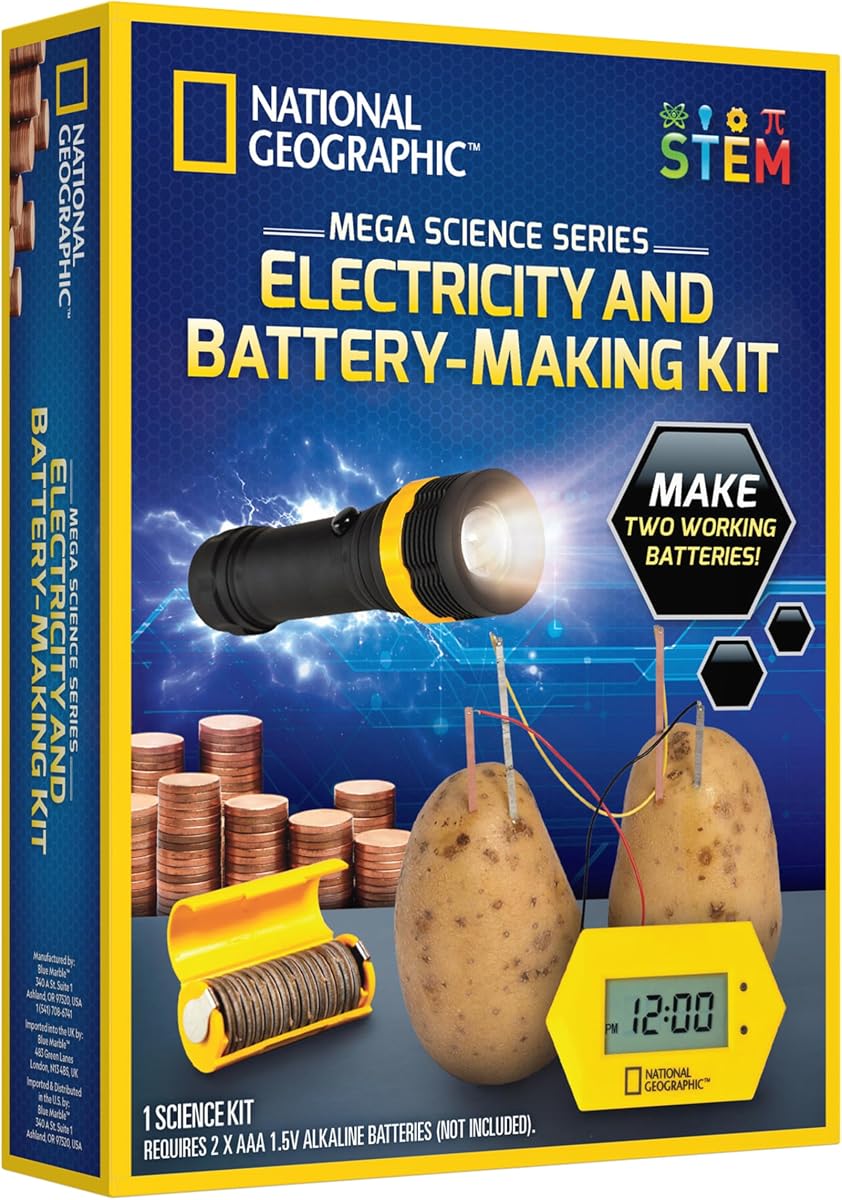
This kit narrows focus to how batteries work chemically. It holds a 4.5 rating and includes components to build a potato clock and penny flashlight for direct energy exploration.
We may earn a commission when you buy through this link, at no additional cost to you.
Kids learn why circuits light up through hands-on battery creation. The voltmeter helps visualize charge levels making abstract energy concepts tangible and understandable.
Though it offers fewer projects than full sets its niche is valuable. It complements broader kits by deepening understanding of power sources specifically.
Families wanting to teach batteries will find this useful. The detailed guide ensures kids grasp the science behind power generation effectively.
Projects like potato batteries show chemical-to-electrical energy conversion clearly without complex wiring.
Including a voltmeter allows kids to measure real energy output from their homemade cells.
We may earn a commission when you buy through this link, at no additional cost to you.
This version extends the basic kit with advanced features like a stair switch circuit. It holds a 4.4 rating and supports grades seven to eleven offering more complex builds like a wind power car.
We may earn a commission when you buy through this link, at no additional cost to you.
A transparent box helps users see parts quickly. Components like LEDs and bulbs allow building traffic lights and other interactive projects for practical application.
The setup is straightforward but needs two AA batteries ready. Students can build a wide range of circuits expanding their understanding of real-world wiring.
Educators needing advanced classroom tools will appreciate this. It balances ease of use with enough complexity to challenge older students effectively.
Stair switch projects teach logic and control circuits beyond simple on-off connections.
Projects like traffic lights show students how circuits control real objects in daily life.
We may earn a commission when you buy through this link, at no additional cost to you.
Selecting the right kit involves balancing component variety, age appropriateness, and educational depth. Below are key factors to consider.
Kits vary significantly by target grade levels. Younger children need safe snap-together parts while teens can handle soldering or precise measurements. Always check manufacturer age labels to match developmental stages.
Match kit complexity to the student's current knowledge level for best results.
Higher project counts offer more longevity and exploration. Look for kits with at least twenty distinct builds to sustain interest over months. Variety ensures students can revisit concepts with new challenges.
A higher project count helps sustain student engagement over time.
Safety components like insulated wires and low voltage are critical for younger users. Avoid kits requiring high voltages or open flames unless supervised. Components should meet child safety standards.
Prioritize safe materials to ensure worry-free exploration.
Organized storage prevents lost parts which can ruin experiments. Look for labeled cases or bags that categorize resistors and switches. This simplifies cleanup and keeps the kit ready for reuse.
Durable storage ensures components remain organized and accessible.
Detailed manuals or video guides are essential for independent learning. Full-color diagrams with step-by-step text help users troubleshoot issues. Poor instructions can stall progress and cause frustration.
Clear instructions are key to successful and stress-free experiments.
Check if batteries are included or if the kit supports solar alternatives. Rechargeable options reduce long-term costs and environmental impact. Ensure voltage requirements match household power availability.
Understand power needs to avoid extra costs before starting.
Kits aligning with school curriculums save time on lesson planning. Look for references to Ohm's law or specific physics concepts. Teachers should verify relevance to local science standards.
Choose kits that align with school or home learning goals.
Some kits allow expansion with additional modules like sensors or motors. This allows learners to scale up as skills grow. Check manufacturer support for extra compatible parts.
Expandable kits grow with the learner's skill level.
Always start with the manual to understand the basic circuit logic. Read safety warnings before connecting any power source to avoid short circuits or component damage.
Keep components dry and store them in the provided case after each session. Avoid mixing old and new batteries to prevent leakage which can corrode sensitive parts.
Encourage learners to design custom builds after mastering the basics. Document successful projects with notes or photos to build a personal reference guide for future experiments.
Kits range from ages eight to high school. Younger kids need simpler snap kits with fewer small parts. Older students can handle complex projects needing precise wiring. Always follow the manufacturer's age guidelines.
Most kits do not include batteries to reduce shipping weight and cost. You typically need AA batteries which are easily available. Always check the product description for specific power requirements before purchasing.
Use the included storage case or divide parts into labeled plastic bags. Keep components like resistors and switches grouped by function to speed up future experiments. A small magnet can help collect metal pieces quickly.
Yes, most kits use low voltage to ensure safety. However supervision is recommended for young children to prevent misuse. Avoid short circuits by following the manual and keeping components dry.
Many kits are designed for classroom use with enough components for group work. Teachers should verify curriculum alignment and safety standards. Bulk purchasing may offer better value for school departments.
Contact the manufacturer directly as many offer warranty support. Most parts are replaceable through customer service or standard electronics stores. Handle fragile items like ammeter gently to extend their lifespan.
We reviewed ten kits offering options for various age groups and goals. The National Geographic kit stands out for project variety while the Sntieecr kit offers affordability.
Prioritize safety and instruction clarity to ensure smooth learning experiences. Matching kit complexity to your child's interest will yield the best educational outcomes.
Prices change frequently so check current listings before buying. Use this guide to find a kit that fits your needs today.