
GLOTRENDS M.2 NVMe to PCIe 4.0 X4 Adapter with Heatsink for NVMe SSD
4.6Editor score
Includes regular and low-profile brackets
Cools SSDs by up to 20°C
Compatible with Gen3 and Gen4 drives
This guide compares the top M2 Pcie Adapter models for NVMe SSDs, covering speed, cooling, compatibility, and installation to help you choose the right
M2 Pcie adapters allow you to add high-speed NVMe storage to systems lacking native M.2 slots. These cards convert standard PCIe slots into M.2 interfaces, enabling faster data transfer and expanded storage options for desktops and workstations.
We evaluated ten leading adapters based on thermal performance, build quality, supported drive sizes, and ease of installation. Our analysis focuses on real-world usability, compatibility with modern motherboards, and the ability to handle sustained workloads without throttling.
Each pick highlights specific strengths like passive cooling, bifurcation support, or budget-friendly design. Note that availability and pricing may change frequently, so verify current stock and specifications before purchasing to ensure compatibility with your specific hardware setup.
4.6Editor score
4.6Editor score

4.4Editor score
The following table provides a side-by-side comparison of all ten selected M2 Pcie adapters. It highlights key specifications such as supported PCIe generations, drive size compatibility, cooling solutions, and unique features to help you quickly identify the best fit for your system.




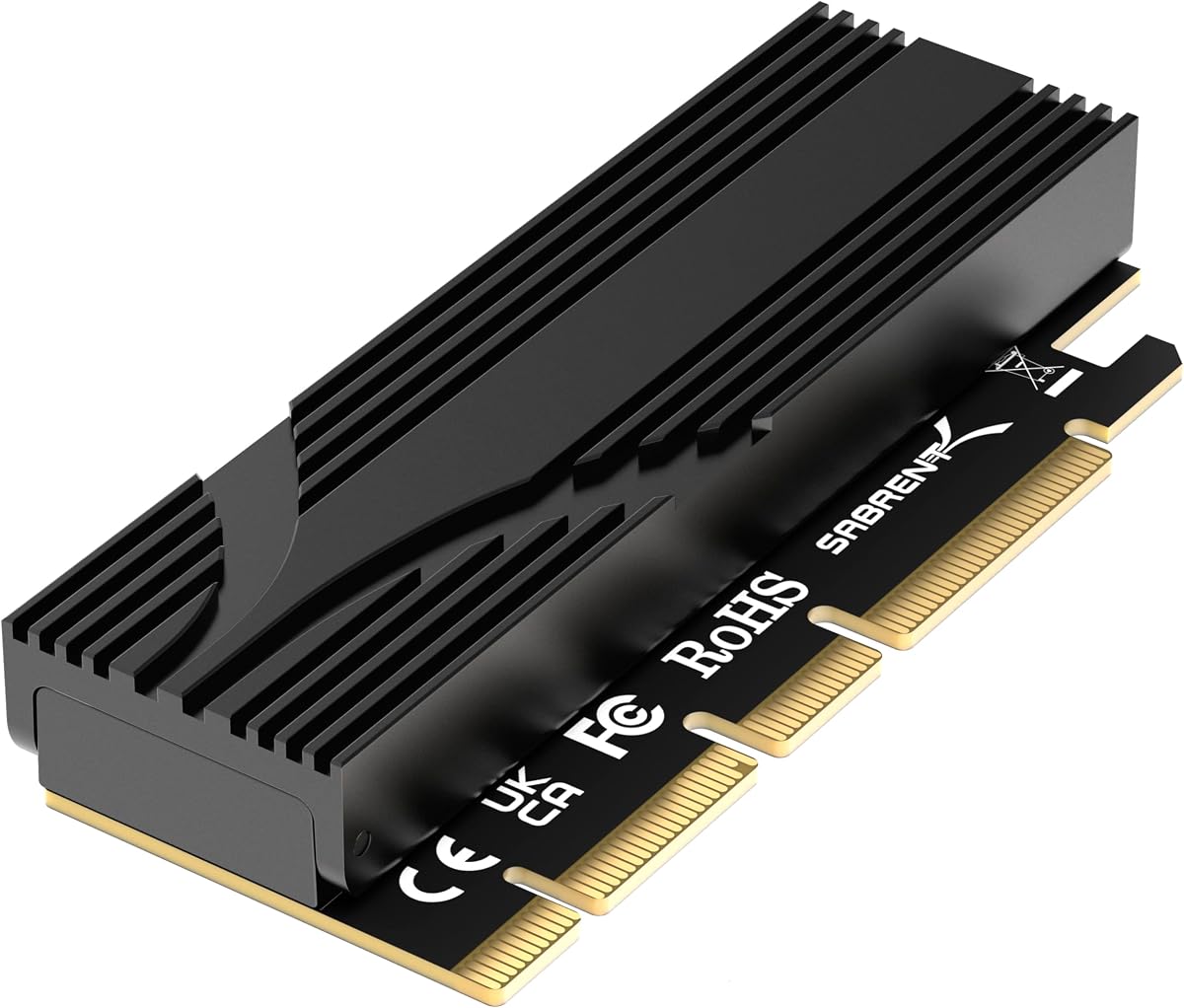
This SABRENT adapter is a top-tier choice for users seeking future-proof storage expansion. It supports PCIe 5.0 speeds when paired with compatible hardware, delivering up to 16GBps bidirectional throughput. The build quality is robust, ensuring stable connections for high-performance NVMe drives.
We may earn a commission when you buy through this link, at no additional cost to you.
The tool-free installation stands out as a major advantage. Users can drop the SSD into place and lock it down without searching for tiny screws. This feature saves time and reduces the risk of stripped screws or lost components during assembly. The aluminum heatsink ensures the drive stays cool even under sustained loads.
While it offers exceptional performance, potential buyers should note the requirement for a full-length PCIe slot. The x16 physical connector may block adjacent slots or conflict with large CPU coolers. Additionally, it only supports M-key NVMe drives, so SATA M.2 users will need a different solution.
For enthusiasts building high-end systems with the latest motherboard capabilities, this adapter is an excellent investment. It maximizes the potential of Gen5 drives without requiring complex bifurcation settings. We recommend it for users prioritizing speed and ease of use over multi-drive capacity.
The card is designed to handle PCIe 5.0 speeds, ensuring compatibility with next-generation motherboards and SSDs. This forward-looking design protects your investment as storage technology continues to evolve rapidly.
Removing the need for screws simplifies the installation process significantly. This design choice makes it easier to swap drives or move them between systems without specialized tools.
We may earn a commission when you buy through this link, at no additional cost to you.
The GLOTRENDS adapter offers exceptional value for users needing reliable NVMe expansion without breaking the bank. It supports both PCIe 3.0 and 4.0 speeds, making it versatile across a wide range of motherboards. The included heatsink significantly reduces operating temperatures for sustained performance.
We may earn a commission when you buy through this link, at no additional cost to you.
One of its strongest features is the inclusion of both regular and low-profile brackets. This flexibility allows installation in various chassis sizes, from full towers to compact ITX cases. The heatsink reduces SSD temperatures by up to 20 degrees, preventing thermal throttling during heavy workloads.
While it lacks support for PCIe x1 slots, it works perfectly in x4, x8, or x16 slots. Users should note that it does not support SATA M.2 drives, so checking drive key type is essential before purchase. Overall, it balances performance and cost effectively.
For budget-conscious builders or those upgrading older systems, this adapter is a smart choice. It provides necessary cooling and bracket options that many competitors omit at this price point. We recommend it for users seeking reliable Gen4 performance at an affordable price.
Including both bracket sizes ensures the adapter fits diverse system cases. This versatility removes barriers for users with smaller form factor chassis who need PCIe expansion.
The included heatsink ensures stable temperatures even during extended use. This passive cooling design avoids the noise and complexity of active fan solutions.
We may earn a commission when you buy through this link, at no additional cost to you.
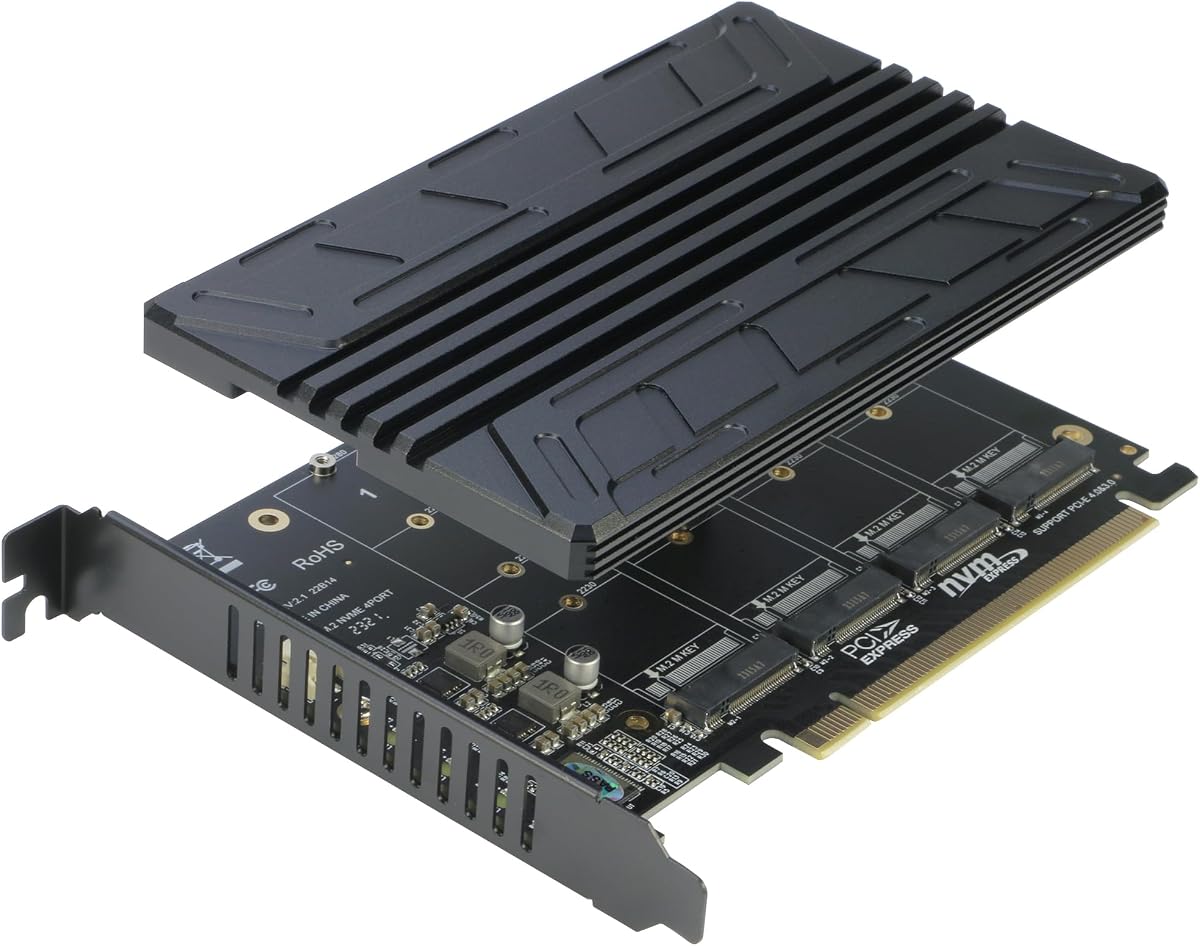
The ASUS Hyper M.2 card is a premium solution for users needing multiple high-speed NVMe drives in a single slot. It supports four NVMe M.2 drives simultaneously, delivering total transfer speeds up to 128 Gbps when paired with capable hardware. This makes it ideal for workstations or RAID setups.
We may earn a commission when you buy through this link, at no additional cost to you.
Its integrated blower-style fan prevents throttling even with four drives running at full capacity. The two-phase power solution ensures stable voltage delivery for all connected drives. This level of robust engineering is rare in adapters at this price tier.
Users must ensure their motherboard supports PCIe x16 bifurcation to utilize all four slots. Without this feature, only one drive may be recognized. The physical size may also obstruct adjacent slots due to the card and fan assembly.
For professionals requiring massive storage capacity and speed, this adapter is unmatched. It supports both Intel VROC and AMD Threadripper configurations, offering broad compatibility for server or workstation builds. We recommend it for users prioritizing multi-drive performance over single-drive simplicity.
The ability to host four NVMe drives in one slot maximizes motherboard slot usage. This is essential for systems needing high capacity without consuming multiple PCIe lanes.
The integrated blower fan actively dissipates heat from all drives. This active cooling ensures consistent performance even when multiple drives are under heavy load simultaneously.
We may earn a commission when you buy through this link, at no additional cost to you.
StarTech is a trusted name in enterprise and IT solutions, and this adapter reflects that reliability. It supports both NVMe and AHCI drives, making it compatible with older legacy systems. The setup is straightforward, relying on native OS support without extra drivers.
We may earn a commission when you buy through this link, at no additional cost to you.
The inclusion of a low-profile bracket ensures flexibility for small form factor systems. Its backward compatibility with PCIe 2.0 and 1.0 means it can still function in older machines, though at lower speeds. The two-year warranty provides peace of mind for professional use.
The limitation lies in its PCIe 3.0 support, which caps performance compared to Gen4 options. It also supports only a single drive. This limits its use for users seeking maximum throughput or multi-drive configurations.
For IT professionals maintaining diverse hardware environments, this adapter offers solid reliability. It bridges the gap between modern NVMe and legacy PCIe standards. We recommend it for users needing stable, simple single-drive expansion with professional-grade support.
Support for both AHCI and NVMe ensures compatibility with a wide range of drives. This flexibility is valuable when managing mixed environments with older and newer hardware.
The two-year warranty and multi-lingual support reflect StarTech's enterprise focus. This service level is crucial for businesses that cannot afford downtime or installation issues.
We may earn a commission when you buy through this link, at no additional cost to you.
This adapter is unique in its ability to support one NVMe and one SATA M.2 drive simultaneously. This hybrid approach is valuable for users needing to use both drive types without consuming multiple PCIe slots. It supports multiple drive sizes including 2230, 2242, 2260, 2280, and 22110.
We may earn a commission when you buy through this link, at no additional cost to you.
The design includes two heat sinks to manage thermal output across both slots. LED indicators provide clear status updates for power and data transfer. Low-profile bracket support ensures compatibility with smaller computer chassis.
The SATA connection requires a separate cable, which adds a step during installation. The SATA port runs at 6Gbps speeds rather than NVMe speeds, so performance varies depending on the drive type used. This limitation must be considered when planning storage strategies.
For users needing a mix of NVMe and SATA in a single slot, this adapter offers a practical solution. It avoids the need to choose between storage types. We recommend it for budget-conscious users with specific mixed-drive requirements.
The ability to accept both SATA and NVMe drives in one slot maximizes utility. This is useful for repurposing existing SATA drives while adding new NVMe capacity.
LED indicators show power and data transfer status for each slot. This visual feedback helps diagnose issues quickly without software tools.
We may earn a commission when you buy through this link, at no additional cost to you.
This adapter provides a comprehensive package for users seeking solid Gen4 performance. It supports up to 64Gbps bandwidth and includes thermal pads for better heat transfer to the aluminum heatsink. The package includes tools and brackets to simplify the installation process.
We may earn a commission when you buy through this link, at no additional cost to you.
Its compatibility extends across most operating systems without requiring additional drivers on modern versions of Windows. The included regular and low-profile brackets accommodate different case sizes. This versatility makes it a strong choice for many builders.
Users on Windows 7 may need to download specific drivers for recognition. The adapter only supports a single drive, which limits its use for storage-heavy needs. These are standard trade-offs for this price point.
For general users looking for reliable Gen4 performance with minimal fuss, this adapter is a great option. It includes almost everything needed for a quick setup. We recommend it for users needing a straightforward and well-equipped expansion card.
The inclusion of thermal pads and tools simplifies setup significantly. Users receive everything needed to secure the drive and ensure thermal efficiency.
Support for modern Windows and Linux systems reduces configuration headaches. Native support means fewer drivers to install and configure.
We may earn a commission when you buy through this link, at no additional cost to you.
The RIITOP Quad adapter allows users to add four NVMe drives in one slot if their motherboard supports bifurcation. It supports Gen4 and Gen3 lanes for up to 4x 32Gbps total bandwidth. The design includes individual LED indicators to show status for each drive.
We may earn a commission when you buy through this link, at no additional cost to you.
The heatsink is relatively thin to avoid blocking adjacent slots. This is crucial in cases where space is tight. It does not support hardware RAID but allows software RAID through OS configuration. This flexibility can be useful for specific use cases.
Setup requires entering BIOS to configure bifurcation settings. Without this step, only one drive will be recognized. This adds complexity compared to single-drive adapters. Users must verify motherboard compatibility before purchasing.
For server or workstation users with compatible hardware, this adapter is a cost-effective way to add storage density. The individual indicators help troubleshoot issues quickly. We recommend it for users needing four drives with sufficient motherboard support.
The thin heatsink design minimizes interference with neighboring components. This is essential for multi-slot setups where space is constrained.
LED indicators per slot provide clear visibility of each drive's status. This allows for easier monitoring and troubleshooting without external software.
We may earn a commission when you buy through this link, at no additional cost to you.
ELUTENG offers a reliable adapter focused on safety and stability. It features solid-state capacitors to regulate voltage and prevent current waves during faults. The low-profile bracket supports installations in smaller systems where vertical space is limited.
We may earn a commission when you buy through this link, at no additional cost to you.
It supports a wide range of operating systems, including older versions of Windows requiring drivers. The aluminum heatsink helps maintain stable performance by managing thermal output. The design ensures consistent operation under various loads.
Theoretical transfer speeds are limited to 16Gb/s, which reflects typical PCIe 3.0/4.0 x4 performance. Users should note the single drive limit, which restricts multi-drive setups. Overall, it focuses on quality and safety over raw speed.
For users prioritizing reliability and safety in compact builds, this adapter is a solid choice. The quality capacitors add a layer of protection for expensive NVMe drives. We recommend it for builders concerned about system stability and longevity.
Solid-state capacitors protect drives from electrical fluctuations. This safety feature is valuable for protecting high-speed storage in less regulated power environments.
The included low-profile bracket ensures the adapter fits small form-factor cases. This allows users to utilize full-size cards in compact chassis.
We may earn a commission when you buy through this link, at no additional cost to you.
This adapter is a straightforward solution for expanding storage with Gen4 speeds. It supports common drive sizes including 2230 through 2280. The aluminum heatsink reduces operating temperatures by 5 to 20 degrees, ensuring sustained performance without throttling.
We may earn a commission when you buy through this link, at no additional cost to you.
It works with PCIe x4, x8, and x16 slots, offering flexibility for different motherboard configurations. The design is simple and efficient, focusing on core functionality without unnecessary complexity. It works well with major NVMe brands.
While it does not include extra software features, the hardware design does the heavy lifting. Users should ensure their system supports Gen4 to get maximum speed. It is a reliable choice for single-drive expansion.
For users needing a simple, effective adapter for NVMe SSDs, this option works well. It provides solid cooling and broad compatibility for common drive types. We recommend it for straightforward storage upgrades in standard systems.
The aluminum heatsink reduces temperature by 5 to 20 degrees effectively. This cooling is essential for maintaining consistent speeds during heavy file transfers.
Support for x4 x8 and x16 slots ensures flexibility in motherboard selection. This means the adapter can adapt to different system configurations.
We may earn a commission when you buy through this link, at no additional cost to you.
This adapter is designed for motherboards with available PCIe x1 slots. It allows users to add NVMe storage without using a valuable x16 slot needed for graphics cards. It supports capacities up to 4TB and common drive sizes.
We may earn a commission when you buy through this link, at no additional cost to you.
It includes both regular and low-profile brackets for chassis flexibility. The adapter is compatible with many operating systems, though Windows 7 may require additional drivers. The bandwidth is limited to x1 speeds, which affects performance.
The x1 limitation means this adapter is not suitable for boot drives where speed is critical. It works best for secondary storage or specific expansion needs. Users should verify their system has a free x1 slot before purchasing.
For systems needing extra storage without consuming high-bandwidth slots, this adapter is a good solution. It is affordable and effective for specific use cases. We recommend it for users with available x1 slots and modest speed needs.
Using a PCIe x1 slot leaves the faster x16 slot free for GPUs. This ensures graphics performance is not compromised by storage expansion.
This adapter provides an affordable way to add NVMe capacity. It is a practical choice for those needing extra space rather than maximum speed.
We may earn a commission when you buy through this link, at no additional cost to you.
Choosing the right adapter depends on your system's specifications and your storage needs. Consider these factors to ensure compatibility and optimal performance.
Ensure the adapter supports your motherboard's PCIe generation. A Gen4 adapter will work in a Gen3 slot but run at slower speeds. For maximum performance, the motherboard slot must match or exceed the adapter's generation.
Always verify your motherboard's PCIe slot generation before purchasing an adapter to avoid performance bottlenecks.
Most adapters only support M-key NVMe drives and not SATA M.2 drives. Check the key type of your SSD. Using an incompatible drive will result in the adapter not recognizing the storage.
Confirm your drive is an M-key NVMe device before selecting an adapter.
Adapters support different physical drive sizes such as 2230, 2242, 2260, 2280, and 22110. Ensure the adapter supports the specific length of your SSD. Some adapters support multiple sizes while others may limit to 2280 only.
Check the supported drive sizes in the product description to ensure your SSD fits.
Multi-drive adapters often require BIOS support for PCIe bifurcation. Without it, multiple drives cannot be recognized on a single slot. Verify your motherboard can split PCIe lanes into x4x4x4x4 configurations if you plan to use a quad adapter.
Confirm bifurcation support in your motherboard specifications for multi-drive setups.
NVMe drives can throttle under sustained load without proper cooling. Look for adapters with aluminum heatsinks or active fans. Passive cooling is common in budget models, but active cooling may be needed for high-performance multi-drive setups.
Prioritize adapters with adequate cooling for your intended workload.
Small form factor cases require low-profile brackets. Check if the adapter includes both standard and low-profile brackets. This ensures you can install the card regardless of your chassis size or layout.
Ensure the adapter includes a bracket that matches your system case profile.
Modern adapters work with Windows 10/11 and Linux without extra drivers. Older systems like Windows 7 may require manual driver installation from the SSD manufacturer. Verify driver requirements if you are using legacy software.
Check the operating system compatibility to avoid driver issues.
Some adapters are tall and may interfere with nearby GPU fans or CPU coolers. Measure the space around your PCIe slot before purchasing. A large heatsink or fan may block adjacent ports or components.
Verify physical clearance in your case to ensure proper installation.
Before installing, power down your computer and disconnect the power supply. Locate a free PCIe slot on your motherboard that matches the adapter's connector. Insert the adapter firmly into the slot until the retention clip secures it. Install the appropriate bracket for your case size using the included screws.
For NVMe SSD installation, insert the drive into the M.2 slot on the adapter. Secure it using the included screw or tool-free mechanism if available. Ensure the SSD is flat and properly seated. Check that the heatsink thermal pad is clean and placed correctly for optimal heat transfer.
Power on your system and enter BIOS to verify the drive is detected. If you use a multi-drive adapter, enable PCIe bifurcation in the BIOS settings. Initialize the drive in your operating system using Disk Management. Regularly update your BIOS to maintain compatibility with newer SSDs and ensure stable performance.
Most adapters are designed specifically for M-key NVMe drives and do not support SATA M.2 drives. You should check the product description to confirm if SATA is supported. If your drive is SATA, you may need a different adapter specifically designed for that interface.
Most modern operating systems like Windows 10 and 11 recognize NVMe drives without extra drivers. Older systems like Windows 7 may require downloading drivers from the SSD manufacturer. Linux and other Unix-like systems typically support NVMe natively.
PCIe bifurcation allows a single PCIe slot to split into multiple logical lanes. You need this feature only if you are using an adapter that supports multiple NVMe drives simultaneously. Without it, the motherboard may only recognize one drive regardless of the adapter's capacity.
Yes, but your motherboard BIOS must support booting from PCIe devices. Most modern boards allow booting from NVMe drives on adapters. Check your motherboard manual to confirm PCIe boot capability. If not supported, the adapter can be used for storage only.
The adapter will run at the speed of the lowest generation in the chain. If you use a Gen4 adapter in a Gen3 slot, it will run at Gen3 speeds. The adapter cannot increase speeds beyond what your motherboard slot supports.
Many adapters come with thermal pads that attach between the SSD and heatsink. These pads replace the need for thermal paste in most cases. Check the product package to see if pads are included. If missing, you can buy separate thermal pads for better cooling.
The top picks offer a range of options from budget-friendly single-drive adapters to premium multi-drive solutions. The SABRENT adapter leads with Gen5 support and tool-free installation, while GLOTRENDS offers great value for Gen4 needs. ASUS provides unmatched multi-drive capability for workstations.
When choosing, prioritize compatibility with your motherboard's PCIe generation and physical clearance in your case. If you need multiple drives, ensure your BIOS supports bifurcation. For most users, a single-drive adapter with a good heatsink provides the best balance of speed and ease of use.
Prices and availability change frequently so verify current stock and specifications before buying. Always check reviews and manufacturer notes to confirm compatibility with your specific hardware. By considering these factors, you can confidently expand your storage with the right adapter for your system.