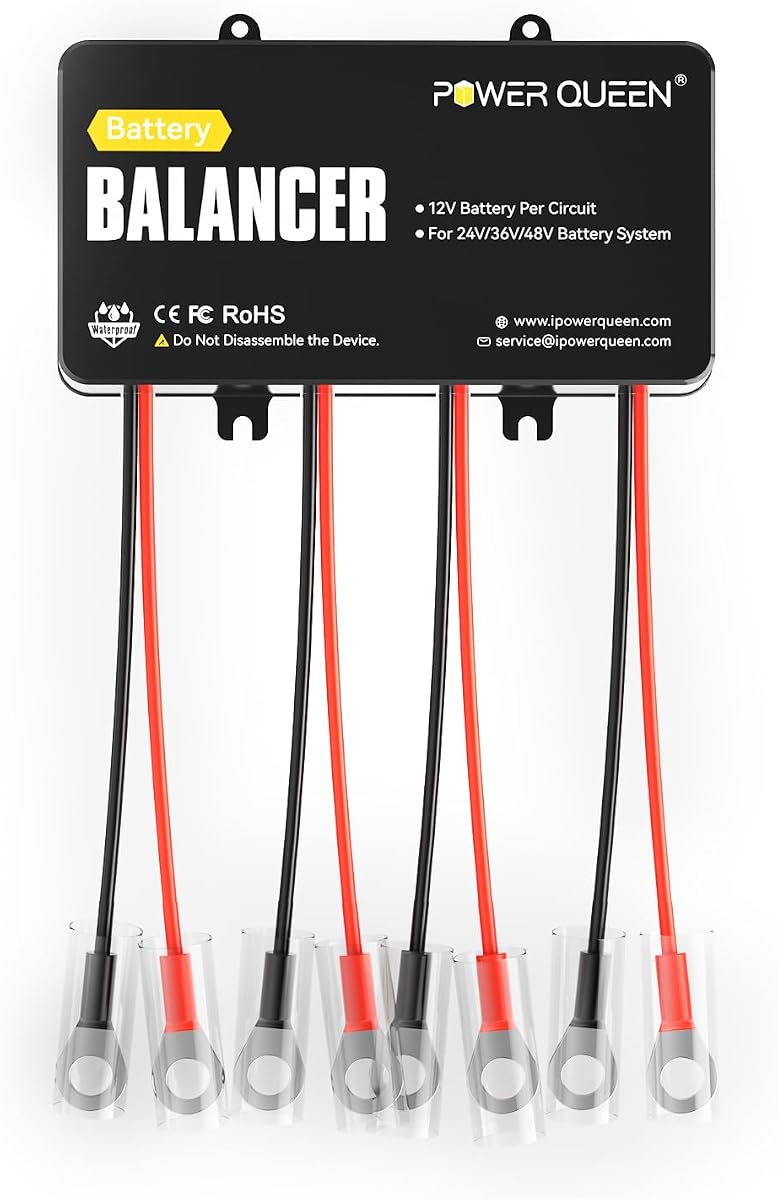
Power Queen Battery Equalizer
4.1Editor score
Four connection ports for 48V
Auto-balancing when voltage diff
Compatible with LiFePO4 and lead
This guide compares top 12V 24V 48V battery equalizer balancers for LiFePO4 and lead acid banks to optimize performance and extend cycle life.
Selecting the right battery equalizer balancer is crucial for maintaining health in multi-battery systems. These devices ensure voltage consistency across series or parallel connections, preventing premature wear and maximizing energy efficiency for your power setup.
We evaluated ten leading models based on compatibility, protection features, and balancing current capabilities. Each product was assessed for its ability to handle 12V, 24V, and 48V configurations while supporting diverse battery chemistries like LiFePO4 and lead acid.
Each pick highlights key specifications, pros, cons, and ideal use cases to help you decide. Please note that product availability and pricing can fluctuate frequently, so verify current details before making a final purchasing decision.
4.1Editor score

4.3Editor score

4.1Editor score
The following table offers a side-by-side comparison of all ten selected battery equalizer balancers. Review the key specifications and features to identify the model that best fits your specific voltage and battery type requirements.


The LiTime 48V Battery Balancer stands out as a top performer for managing complex battery banks. With a 4.3 rating, it offers reliable active balancing and comprehensive safety features that protect your investment.
We may earn a commission when you buy through this link, at no additional cost to you.
Its ability to handle 48V systems using distinct connection ports makes it ideal for large setups like RVs or off-grid storage. The reverse polarity protection ensures accidental wiring errors do not cause damage, while high temperature protection prevents overheating.
Users may find the installation requires careful attention to series and parallel configurations. However, these trade-offs are acceptable given the extended battery lifespan and optimized performance the device delivers.
This model is best for users with 48V banks who need reliable, long-term balancing. It remains a trusted companion for optimizing battery health across diverse applications.
Active balancing functions optimize battery performance and extend lifespan by ensuring all cells reach the same state of charge.
Reverse polarity and high temperature protection mechanisms safeguard the unit and battery bank from common electrical hazards.
We may earn a commission when you buy through this link, at no additional cost to you.
The Power Queen Battery Balancer 48V offers excellent value for users seeking reliable voltage equalization. Its strong ratings reflect consistent performance in maintaining balance across various battery systems.
We may earn a commission when you buy through this link, at no additional cost to you.
Featuring four connection ports, it handles 24V to 48V banks efficiently. Advanced safety safeguards like reverse polarity protection prevent damage from wiring mistakes, ensuring reliable operation over time.
Some users may need to adapt to the parallel-first-series-later requirement for series-parallel systems. This is a minor trade-off compared to the cost savings and versatility the unit provides.
Ideal for budget-conscious RV or solar users, this balancer delivers essential protection without breaking the bank. It is a practical solution for maximizing battery longevity.
Designed to work with LiFePO4, lithium-ion, and lead-acid types, making it a versatile choice for diverse battery needs.
Switches to low-power standby mode drawing just 5mA when balanced, conserving energy without compromising performance.
We may earn a commission when you buy through this link, at no additional cost to you.
The MAZAVA Battery Equalizer HX02 combines functionality with advanced monitoring via an integrated LCD display. It appeals to users who prioritize visibility and control over their battery bank status.
We may earn a commission when you buy through this link, at no additional cost to you.
Its aluminum alloy shell ensures better heat dissipation, which is critical for high-load environments. The multi-module parallel support allows scaling for larger systems like 48V or higher setups effectively.
Installation might be more complex due to the multiple module requirements. However, the precision voltage monitoring and durable build justify the investment for demanding applications.
This model suits professionals or enthusiasts needing detailed insights and robust construction. It delivers premium performance for optimizing battery health in critical systems.
The LCD display shows battery voltage in thousandths, enabling fast and precise equalization adjustments.
Aluminum alloy shell design promotes superior heat dissipation to maintain stable performance during operation.
We may earn a commission when you buy through this link, at no additional cost to you.
Victron Energy Battery Balancer provides robust solution for managing 24V battery banks with multiple series strings. Known for reliability, it ensures consistent state of charge across all connected batteries.
We may earn a commission when you buy through this link, at no additional cost to you.
When voltage exceeds 27V, it draws up to 1Amp to balance the system effectively. This feature eliminates load imbalance and improves overall battery bank life significantly.
It may be less suitable for higher voltage setups requiring multiple units. Still, its proven performance in marine and solar contexts makes it a solid choice.
Recommended for users with 24V systems needing proven durability. It delivers consistent balancing to maintain battery health over time.
Equalizes charge of several parallel strings of series connected batteries for consistent overall performance.
Turns on automatically when system charge voltage rises above 27V to maintain balanced state of charge.
We may earn a commission when you buy through this link, at no additional cost to you.
This Battery Equalizer is ideal for high-voltage configurations needing flexible voltage balancing. With compatibility up to 96V, it serves a wide range of automotive and industrial applications effectively.
We may earn a commission when you buy through this link, at no additional cost to you.
Rail-type buckle installation simplifies setup in distribution boxes. It maintains charge balance between series or parallel connected batteries to extend service life.
Users should ensure correct wiring for series connections to maximize benefits. However, its broad compatibility and affordable price make it a versatile choice.
Best for users managing large battery groups needing simple balancing. It delivers reliable performance across many battery types.
Handles 12V to 96V systems, making it suitable for trucks, golf carts, and forklifts.
Rail-type buckle design allows easy module installation in distribution boxes for efficient maintenance.
We may earn a commission when you buy through this link, at no additional cost to you.
The HC02 Balancer offers clear visual feedback via an LED display. This feature helps users monitor voltage status easily while balancing 48V systems effectively.
We may earn a commission when you buy through this link, at no additional cost to you.
It includes essential safety features like reverse polarity and low voltage disconnect. Multiple units can connect in parallel to handle 96V or higher voltage groups.
Installation requires careful setup to ensure proper wiring across the four batteries. Despite this, it remains a practical tool for visual monitoring.
Recommended for users needing voltage visibility in 48V banks. It provides simple protection and feedback for battery maintenance.
LED display provides clear visibility of voltage status for easy monitoring during balancing.
Multiple units can be connected in parallel to support higher voltage battery groups like 96V.
We may earn a commission when you buy through this link, at no additional cost to you.
The Redodo 24V Battery Equalizer is designed for dual series systems with strong performance. With a 4.4 rating, it delivers effective balancing and includes helpful installation accessories.
We may earn a commission when you buy through this link, at no additional cost to you.
Its 10A max current ensures rapid equalization when pressure differences occur. The included M8 OT terminals simplify wiring for marine or automotive applications.
Users must ensure voltage stays within the 3-18V single range. However, its protection features and warranty add significant value.
Best for 24V systems needing reliable dual-series balancing. It combines performance with practical design for easy setup.
Maximum 10A equalization current helps reduce pressure differences quickly to maintain balance.
M8 OT terminals and high-temperature protection ensure robust connection and safe operation.
We may earn a commission when you buy through this link, at no additional cost to you.
The Power Queen 48V Battery Equalizer delivers reliable performance for balancing large battery banks. Its active balancing technology ensures long-term efficiency across diverse battery types.
We may earn a commission when you buy through this link, at no additional cost to you.
It activates automatically when voltage differences exceed 10mV, keeping the system stable. Safety features like high-temperature protection prevent operational hazards during extended use.
Wiring must follow parallel-first-series-later guidelines. While this adds complexity, the resulting stability is worth the effort for most users.
Ideal for 48V bank owners seeking dependable mid-range performance. It provides essential protection and balancing at a fair price point.
Automatically activates when voltage difference exceeds 10mV for timely and effective balancing.
Switches to low-power standby drawing just 5mA once voltage difference is below 10mV.
We may earn a commission when you buy through this link, at no additional cost to you.
This Battery Equalizer provides straightforward balancing for 24V to 48V systems. It ensures charge and discharge balance while offering essential protection against voltage issues.
We may earn a commission when you buy through this link, at no additional cost to you.
Indicator lights provide clear visibility of working status. Users can connect multiple units in parallel for higher-voltage battery systems as needed.
The 5A current limit may not suit high-demand scenarios. However, its simplicity and protective functions make it effective for standard applications.
Recommended for users seeking uncomplicated battery balancing. It offers reliable protection and balance without complex features.
Smart indicator lights offer clear visibility of the balancer's working status at a glance.
Multiple balancers can be connected in parallel to accommodate 48V or higher-voltage systems.
We may earn a commission when you buy through this link, at no additional cost to you.
The HA01 Equalizer offers clear visual feedback via an LED display. It helps maintain voltage balance in 24V to 48V systems effectively.
We may earn a commission when you buy through this link, at no additional cost to you.
With flame retardant materials and low voltage disconnection, it prioritizes safety during operation. Users can adjust compensation current up to 5A for balancing.
Setup requires specific wiring steps like connecting the white wire to the middle point. While manageable, it may challenge novice installers.
Suitable for users needing visual feedback and basic protection. It balances voltage reliably in diverse battery configurations.
LED digital display allows users to conveniently check product voltage status during operation.
Low voltage disconnection and flame retardant shell protect the system from electrical hazards.
We may earn a commission when you buy through this link, at no additional cost to you.
Selecting the right balancer requires understanding your voltage system and battery chemistry. This guide outlines key factors to ensure optimal compatibility and performance for your power bank.
Ensure the balancer supports your bank's maximum voltage, such as 24V or 48V. Some models allow multiple units to connect in parallel for higher voltages.
Verify that the device matches your system's configuration to avoid potential damage or ineffective balancing.
Choose a balancer compatible with your chemistry, including LiFePO4 or lead acid. Different chemistries have unique voltage characteristics that affect performance.
Select a model explicitly listed as supporting your battery type for reliable operation.
Higher current capacity speeds up the equalization process during high-demand scenarios. Look for models offering at least 5A to 10A for efficient performance.
Match the current rating to your battery capacity needs for best results.
Safety features like reverse polarity protection and temperature safeguards are essential. These prevent damage from wiring errors or overheating.
Prioritize units with multiple protection layers for reliable long-term operation.
LED displays provide visibility into voltage differences and current status. This helps with real-time monitoring and troubleshooting.
Consider models with displays if you need frequent status checks.
Some balancers require specific wiring configurations like parallel-first-series-later. Ensure you have the tools and knowledge to install correctly.
Choose models that offer user-friendly terminals for easier setup.
Low-power standby modes minimize energy drain when the system is balanced. This is critical for off-grid or solar setups.
Look for models with low standby current to preserve battery health.
Reputable brands often offer better build quality and support. Check warranty terms and technical support availability before purchasing.
Ensure there is reliable customer support for troubleshooting.
Begin by verifying the voltage rating matches your battery bank configuration. Connect the positive and negative terminals securely using the provided cables.
Ensure wiring follows the recommended series-parallel order to prevent short circuits. Most balancers auto-activate when voltage differences are detected.
Regularly inspect connections for corrosion or wear to maintain efficiency. Allow the unit to run in standby mode when balanced to save power.
Yes, many balancers are designed to support LiFePO4 chemistries. Ensure the model specifically lists LiFePO4 compatibility to avoid issues. Different battery types have unique voltage characteristics that require matching devices.
Generally, no. Most 12V balancers are not suitable for 24V systems. Always check the voltage specifications before installation to avoid damage. Using incompatible voltage ranges can lead to failure.
Indicator lights or displays typically show active balancing status. Monitor voltage differences to confirm it is reducing them. Some models have audible alerts or status changes.
Active balancing redirects energy between cells while passive uses resistors to burn excess. Active methods are more efficient for complex setups. Passive methods are simpler but waste energy.
Most modern balancers are safe for long-term connection. They automatically enter low-power standby when balanced. Always verify manufacturer guidelines for permanent installation safety.
Yes, they help prevent over-discharge and uneven cell wear. Balancing voltage differences improves overall system efficiency. This leads to longer cycle times and health.
Selecting the right battery equalizer depends on your specific voltage and chemistry needs. The LiTime and Power Queen models offer strong balance of performance and affordability.
Prioritize protection features and compatibility to ensure long-term reliability. Proper installation is key to maximizing the benefits of these devices.
Prices fluctuate frequently, so check current availability before purchasing. Review the comparison table to find the model that fits your setup best.