
Yxk Zero1 2-Bay Desktop NAS for Home & Personal Storage (Diskless)
4.4Editor score
2.5GbE network speed
Docker support included
Compact and quiet design
This comprehensive guide compares the top diskless NAS enclosures for home and business, evaluating performance, storage capacity, software features, and value
Diskless NAS enclosures provide a flexible foundation for building a private cloud without committing to specific drive types upfront. These devices let you select compatible hard drives or SSDs based on your exact storage needs and budget constraints. Choosing the right enclosure ensures you get reliable data protection and efficient file sharing across all your devices.
We evaluated ten leading models based on hardware performance, software ecosystem, network connectivity, and overall ease of use. Our analysis covers entry-level home units to powerful workstation-grade systems suitable for creative professionals and small businesses. Each product was assessed for its ability to deliver secure, scalable, and fast storage solutions.
Every pick in this list includes detailed specifications, real-world performance insights, and clear pros and cons to guide your decision. Remember that storage device prices fluctuate frequently, so always check current listings before purchasing. This guide helps you invest wisely in technology that protects your digital assets long term.
4.4Editor score

4.6Editor score

4.6Editor score
The following table provides a side-by-side comparison of all ten diskless NAS enclosures reviewed in this guide, highlighting key specifications and unique selling points.




The Synology 2-Bay DiskStation DS223j stands out as the most reliable entry-level option for users seeking a seamless private cloud experience. With a solid 4.6-star rating, it delivers consistent performance for file sharing, media streaming, and automated backups without requiring technical expertise. Its intuitive software makes it ideal for beginners.
We may earn a commission when you buy through this link, at no additional cost to you.
This unit excels in security and accessibility, offering 100% data ownership and multi-platform access from anywhere. The automated backup protection ensures your Macs, PCs, and mobile devices are safely backed up to multiple destinations. Integrated home security system support allows you to monitor your property 24/7 with compatible IP cameras.
While the RAM is limited to 1GB non-expandable on this model, the efficient Synology DSM OS minimizes memory demands for basic tasks. The single Gigabit Ethernet port limits network throughput compared to newer models with 2.5GbE, but it remains sufficient for typical home use and media streaming needs.
Buy this if you prioritize simplicity, reliability, and long-term software support for a home NAS. It is the perfect starting point for anyone wanting to escape cloud subscription fees and maintain complete control over their personal data and media libraries.
Synology DSM provides a polished, app-based interface that rivals consumer operating systems, making file management and remote access incredibly intuitive.
End-to-end encryption, two-factor authentication, and automatic security updates protect your data from unauthorized access and emerging online threats.
We may earn a commission when you buy through this link, at no additional cost to you.
The TERRAMASTER D8 Hybrid 2 is a unique device combining HDD capacity with SSD speed in a single USB enclosure. With a perfect 5.0 rating, it appeals to users needing massive storage alongside fast access for video editing or large file transfers. Its hybrid design is unmatched in this category.
We may earn a commission when you buy through this link, at no additional cost to you.
It supports four independent HDDs and four independent M.2 NVMe SSDs, allowing flexible storage configuration without forced RAID. The USB 3.2 Gen2 protocol delivers read speeds up to 1020 MB/s using a single NVMe SSD, enabling rapid file transfers and smooth workflow efficiency for creative tasks.
The included TPM technology optimizes power efficiency and operational safety by letting you switch between Power Save and Active modes. While it lacks built-in RAID for redundancy, third-party software can be used if needed. The device is highly compatible across Windows, macOS, Linux, and NAS operating systems.
This enclosure is ideal for creators who want high-speed access to frequently used files while archiving large media libraries on HDDs. It serves as an excellent external DAS expansion for workstations needing both capacity and performance without network complexity.
The USB 3.2 Gen2 interface bypasses network bottlenecks, delivering direct high-speed access to your storage from any compatible computer.
Independent drive support means you can use different drive types and sizes together, optimizing costs and performance for various data tiers.
We may earn a commission when you buy through this link, at no additional cost to you.
The Yxk Zero1 2-Bay Desktop NAS offers an exceptional entry point for users seeking private storage without monthly cloud fees. Its 4.4 rating reflects strong value and performance for basic home storage needs. The device stands out with a faster 2.5GbE port at this budget price tier.
We may earn a commission when you buy through this link, at no additional cost to you.
Users can enjoy blazing transfer speeds for 4K streaming and quick backups thanks to the 2.5GbE connectivity. Docker support allows for expanding functionality with self-hosted applications once you become comfortable with the system. The compact and whisper-quiet design fits seamlessly into any home environment.
The one-time investment model ensures you own your data and storage capacity without recurring subscriptions or imposed limits. While the software ecosystem is less mature than established brands, it provides essential features like remote access, granular permissions, and real-time health monitoring effectively.
This NAS is perfect for individuals or families wanting to centralize photos, videos, and files affordably. It is especially suitable for beginners who want to explore private cloud storage without a steep learning curve or significant financial commitment.
The 2.5GbE port ensures the device remains relevant as network speeds increase, protecting your investment from becoming obsolete quickly.
Docker support opens doors to run diverse containers and applications, allowing the NAS to adapt to evolving personal tech needs.
We may earn a commission when you buy through this link, at no additional cost to you.
The UGREEN NAS DXP4800 GT delivers workstation-grade performance with its AMD Ryzen embedded processor and dual 10GbE networking. Rated 4.6 stars, it handles heavy workloads like 4K/8K editing, media processing, and multi-user access smoothly. This makes it ideal for professional creators and office teams.
We may earn a commission when you buy through this link, at no additional cost to you.
UGOS Pro software offers a clean, guided interface alongside advanced capabilities like Docker, virtual machines, and SAN Manager. The built-in Surveillance Center supports ONVIF/RTSP cameras for centralized security recording without cloud subscriptions. An SD card slot allows instant photo and video imports directly into the NAS.
With support for up to 144TB total capacity via SATA and NVMe drives, storage scalability is excellent. The 10GbE ports enable theoretical throughput up to 2.5GB/s with link aggregation, ensuring fast large file transfers and stable streaming. ECC RAM upgrades are supported for enhanced data integrity.
Choose this NAS if you need enterprise-level performance at a workstation price for professional workflows. It combines powerful hardware with user-friendly software, offering a robust platform for creative projects, small business data management, and demanding media applications.
The combination of powerful CPU, fast networking, and local editing support streamlines complex media workflows significantly.
Integrated surveillance features eliminate the need for separate NVR hardware, reducing costs and simplifying home or office monitoring.
We may earn a commission when you buy through this link, at no additional cost to you.
The QNAP TR-004 is a specialized Direct Attached Storage device designed primarily to expand existing QNAP NAS systems. With a 4.2 rating, it provides reliable high-capacity storage via USB Type-C with hardware RAID options. It is essential for users needing more local storage without adding network complexity.
We may earn a commission when you buy through this link, at no additional cost to you.
It supports hardware RAID configurations including 0, 1, 5, and JBOD, ensuring data redundancy and performance. The USB Type-C connection offers fast data transfer rates, making it suitable for video editing workstations or backup destinations. Lockable drive bays add a layer of physical security for sensitive data.
While it cannot function as a standalone NAS, it integrates seamlessly as an external storage pool or volume on compatible QNAP systems. The lockable drive bays and hardware RAID provide robust protection. However, applications installed on the connected NAS cannot run directly on the TR-004 itself.
This device is best for expanding storage on existing QNAP ecosystems or serving as a high-speed external backup drive. It delivers professional-grade reliability and security for data centers or professional workstations needing direct, redundant storage.
Built-in RAID processing offloads work from your computer, providing faster and more reliable data protection than software solutions.
Lockable bays prevent unauthorized drive removal, adding physical security layers critical for shared office environments.
We may earn a commission when you buy through this link, at no additional cost to you.
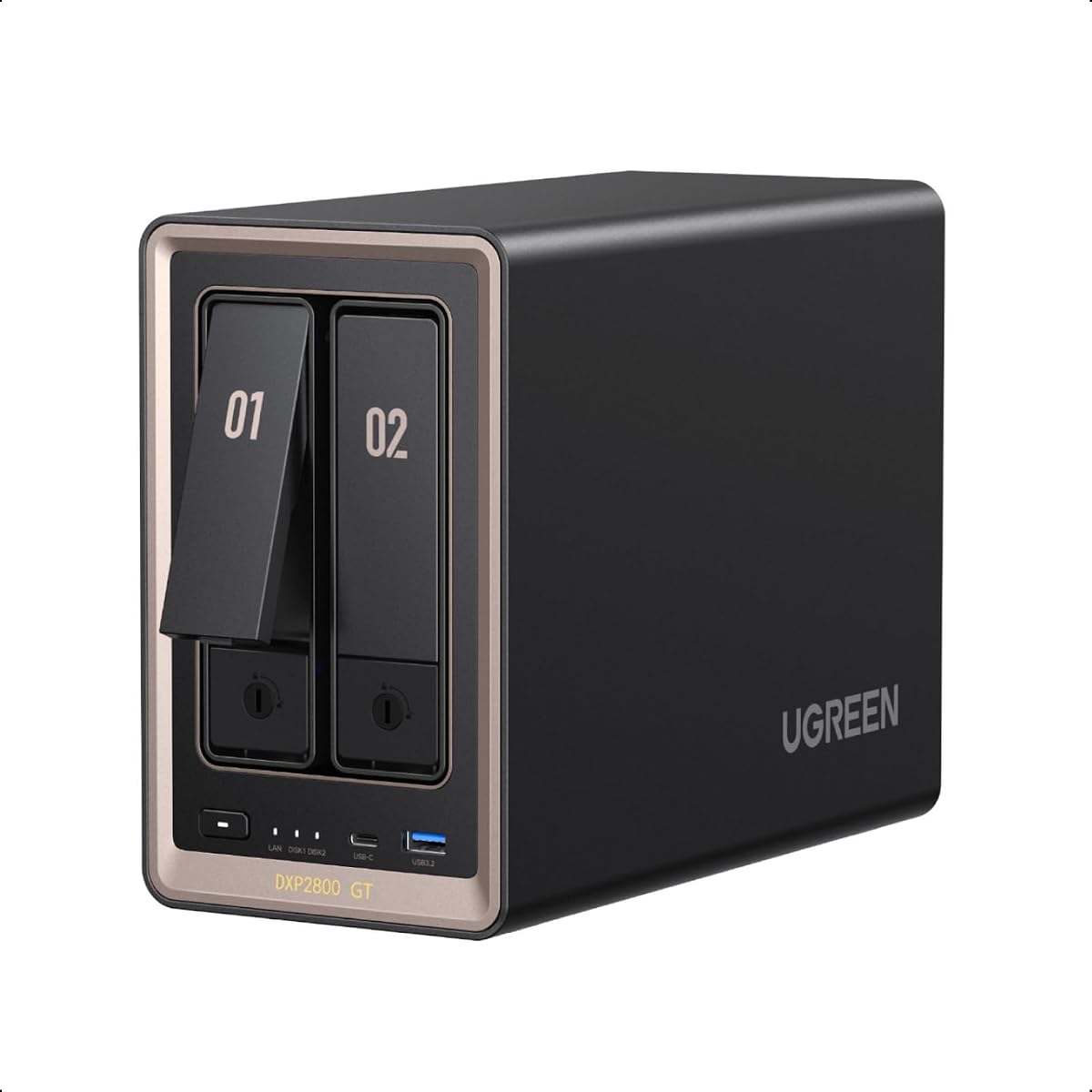
The UGREEN DXP2800 GT is a compact powerhouse tailored for freelancers and creators needing reliable speed and capacity. Rated 4.2 stars, it combines the same AMD Ryzen processor as higher-end models in a smaller form factor. This makes it ideal for solo professionals managing growing digital assets efficiently.
We may earn a commission when you buy through this link, at no additional cost to you.
It supports up to 80TB total capacity and features a 10GbE port for fast network transfers essential for large file workflows. The Surveillance Center keeps security footage local and accessible without cloud fees. Docker and virtual machine support allow for flexible self-hosted app deployment.
Privacy is ensured through multi-layer encryption including TLS/SSL, RSA, AES, and SHA-512. RAID 1 support adds redundancy to protect against drive failure. The UGOS Pro interface simplifies management while offering advanced features like global search and photo organization tools.
Freelancers and home office users should choose this for its balance of performance, privacy, and price. It offers professional capabilities without the bulk of larger enterprise systems, making it perfect for remote work and content creation.
Local storage ensures client data remains private and secure, avoiding third-party cloud risks and potential breaches.
Docker and VM support let you run custom services like project management or file sync tools privately on your own server.
We may earn a commission when you buy through this link, at no additional cost to you.
The Synology 4-Bay DiskStation DS925+ is a solid step up for home office users needing more capacity and redundancy. With a 4.2 rating, it offers dual 2.5GbE ports for significantly faster file sharing than standard Gigabit networks. Its reliable hardware ensures stable performance for business tasks.
We may earn a commission when you buy through this link, at no additional cost to you.
It features built-in file and photo management, virtualization, and robust surveillance solutions. The dual ports provide network redundancy and increased bandwidth, crucial for multi-user home offices. Synology DSM continues to offer the best user experience and third-party app compatibility in the NAS market.
Drive compatibility is maintained through Synology's official compatibility list, ensuring hardware reliability. The 3-year limited hardware warranty adds peace of mind for professional use. While RAM is not expandable on this model, the efficient OS manages typical workloads without issue.
This unit is recommended for small teams or home offices needing a centralized, secure data repository. It bridges the gap between consumer and business NAS, providing enterprise features in a compact, user-friendly design.
Dual Ethernet ports ensure network connection stability, preventing downtime during critical file transfers or video conferences.
Integrated surveillance support lets you repurpose the NAS for security monitoring, saving costs on separate hardware.
We may earn a commission when you buy through this link, at no additional cost to you.
The Synology DS425+ is engineered for teams requiring high throughput and strict access controls. Rated 4.6 stars, it supports concurrent access from 10+ users, making it ideal for small business media hubs or production teams. Its centralized repository simplifies document and asset management significantly.
We may earn a commission when you buy through this link, at no additional cost to you.
It includes granular access controls and audit logs for tracking file changes and ensuring accountability. The multi-layered data protection combines RAID redundancy with automated backups and snapshots to prevent data loss. The professional surveillance system supports up to 30 IP cameras for extensive monitoring.
Dedicated technical account management is available for business-critical production environments, ensuring reliable support. The 3-year warranty provides long-term security for your investment. This device is optimized for environments where data integrity and security are non-negotiable.
Choose this for office teams handling sensitive documents or large media libraries needing strict access protocols. It delivers robust enterprise features with Synology's signature ease of use, suitable for business-critical workloads.
Granular permissions ensure employees access only relevant files, preventing accidental exposure or tampering of sensitive data.
Integrated support for up to 30 cameras turns the NAS into a full security hub for office or warehouse monitoring.
We may earn a commission when you buy through this link, at no additional cost to you.
The Synology 5-Bay Expansion Unit DX525 allows you to add significant storage capacity to compatible DiskStation models. Rated 4.6 stars, it supports five additional 3.5-inch or 2.5-inch SATA drives, making it a versatile solution for growing data needs. Its plug-and-play nature ensures easy installation.
We may earn a commission when you buy through this link, at no additional cost to you.
Configuration happens quickly via Synology DSM's unified tools, integrating seamlessly into your existing storage pool. Hot-swapping support means you can replace drives without powering down the system, minimizing downtime. The unit maintains the same reliability and support standards as the main NAS.
Backed by Synology's 3-year limited hardware warranty, it provides long-term confidence for expanding your infrastructure. This expansion is cost-effective compared to buying a new larger NAS unit later. It allows your system to grow alongside your data accumulation.
This unit is perfect for users anticipating storage growth who want a reliable, integrated expansion path. It ensures your NAS remains a central, scalable hub without needing frequent hardware replacements as data needs increase.
DSM treats the expansion unit as part of the main storage pool, simplifying management and backup processes.
Drive replacements happen without interruption, keeping data accessible even during maintenance or drive failure scenarios.
We may earn a commission when you buy through this link, at no additional cost to you.
The TrueNAS Mini X+ is a compact enterprise server with the self-healing ZFS filesystem for ultimate data integrity. Rated 4.3 stars, it features 32GB ECC RAM and an 8-Core CPU, providing exceptional processing power for virtualization and complex tasks. This makes it suitable for advanced users needing enterprise reliability.
We may earn a commission when you buy through this link, at no additional cost to you.
TrueNAS Community Edition supports multiple protocols like NFS, SMB, and iSCSI for versatile file sharing. The self-healing ZFS protects data from corruption and ransomware via snapshots and checksums. Remote management via IPMI allows monitoring even when the server is offline.
With 5+2 drive bays supporting hot-swapping, storage capacity and accessibility are excellent. The dual 1/10 Gigabit network provides high-speed connectivity options. While the setup is more technical than standard NAS units, the reliability is unmatched for mission-critical data.
Choose this for professional environments or tech enthusiasts needing maximum data protection and virtualization. It delivers the power of an enterprise storage system in a compact form factor, perfect for demanding technical workflows.
ZFS checksumming and self-healing capabilities ensure your data remains intact and free from silent corruption over time.
IPMI remote management allows system admins to monitor and control the server remotely, ensuring high availability.
We may earn a commission when you buy through this link, at no additional cost to you.
Selecting the right diskless NAS enclosure involves balancing performance, storage capacity, and software features to match your specific use case.
Consider how many drives you need now and how many you may need in the future. Some enclosures support only SATA HDDs, while others add NVMe SSD slots for hybrid performance. Ensure the bays support the drive sizes you plan to use.
Choose a bay count that matches your growth plan; 2-bay units are entry-level, while 4 or 5-bay units support redundancy and massive capacity expansion.
Network speed directly impacts file transfer rates and streaming performance. Look for 2.5GbE or 10GbE ports if you handle large files or multiple users. Standard Gigabit ports limit throughput to about 110 MB/s regardless of drive speed.
Prioritize models with faster Ethernet ports if you plan to stream 4K video, edit media remotely, or share files frequently across a network.
The operating system determines ease of use and feature availability. Established brands like Synology offer mature software with intuitive interfaces and extensive apps. Newer brands may offer competitive hardware but less polished software.
Pick an OS that supports your workflow needs like Docker, virtualization, or specific media server apps to maximize the NAS utility.
CPU and RAM handle tasks beyond file sharing like transcoding video or running apps. More cores and threads allow better multitasking and handling multiple user requests. Expandable RAM future-proofs your investment.
For basic file storage, entry-level processors suffice; for media transcoding or virtualization, choose models with higher-end CPUs and expandable memory.
RAID support or redundancy protects against drive failure. Hardware RAID processes faster, while software RAID offers more flexibility. Snapshot technology adds another layer against ransomware and accidental deletion.
Ensure your chosen model supports RAID levels that meet your data safety needs and understand how backups are managed alongside redundancy.
Many modern NAS units include built-in surveillance support allowing you to connect IP cameras. This saves money on separate NVRs. Look for support for your camera brand and sufficient license slots for the number of cameras.
Check media server integration like Plex or Emby if you want to stream media; built-in transcoding support ensures smooth playback on various devices.
Hardware warranties protect your investment from manufacturing defects. Brands offering 3-year or more warranties typically provide better long-term reliability. Customer support responsiveness is crucial for troubleshooting.
Prioritize brands with strong community forums and official support channels to ensure you get help when needed.
Size and noise level matter for home placement. Compact, quiet models blend into living spaces better than bulky, fan-heavy units. Consider cooling systems and operating temperatures.
Choose a form factor that fits your environment while ensuring adequate cooling to maintain drive longevity and performance.
Install compatible hard drives or SSDs into the drive bays carefully, aligning the connectors correctly. Secure the drives using the provided screws or tool-less mechanisms. Ensure all cables are properly connected to the motherboard.
Connect the NAS to your router via Ethernet and power it on. Follow the manufacturer's setup wizard to update firmware, create admin accounts, and format drives. Install companion mobile and desktop apps for seamless access.
Regularly update firmware and software to patch security vulnerabilities. Monitor drive health using built-in tools and replace drives before failure. Schedule automated backups to external devices or cloud services for comprehensive data protection.
Diskless NAS means the device is sold without hard drives installed. You purchase and install compatible drives separately, allowing you to choose your preferred brand, capacity, and type based on your budget and needs.
Not every drive is optimized for NAS use. Drives designed for 24/7 operation like WD Red or Seagate IronWolf are recommended for reliability. Check the manufacturer's compatibility list to ensure your drives work with the model you buy.
RAID provides redundancy so your data survives drive failure. While not strictly necessary, it is highly recommended for important files. Mirroring (RAID 1) or parity (RAID 5) configurations protect data at a cost of some total capacity.
Most NAS systems offer remote access apps that securely connect to your home network over the internet. Set up user accounts and permissions to share files with family or coworkers. Ensure your network security is configured properly.
NAS devices are generally energy efficient, consuming between 20 to 50 watts depending on drives and usage. Modern units have sleep modes to reduce power when idle. Using energy-efficient drives further lowers consumption.
A NAS connects to your network and allows multiple devices to access files simultaneously, whereas external drives connect to one computer. NAS offers advanced features like automation, remote access, and data protection that external drives typically lack.
The Synology DS223j, Yxk Zero1, and UGREEN DXP4800 GT represent the top choices across different budgets and performance needs. Each offers unique advantages depending on whether you prioritize ease of use, affordability, or raw power.
Prioritize network speed and software features that match your workflow. If you handle large files or multiple users, faster Ethernet ports and robust OS support are critical. For simple personal storage, entry-level units provide excellent value.
Prices and stock availability change frequently so verify current deals before purchasing. Investing in the right diskless NAS ensures your data remains secure, accessible, and scalable for years to come.